

Take the Stairs for Europe’s Most Insightful Views
By Rick Steves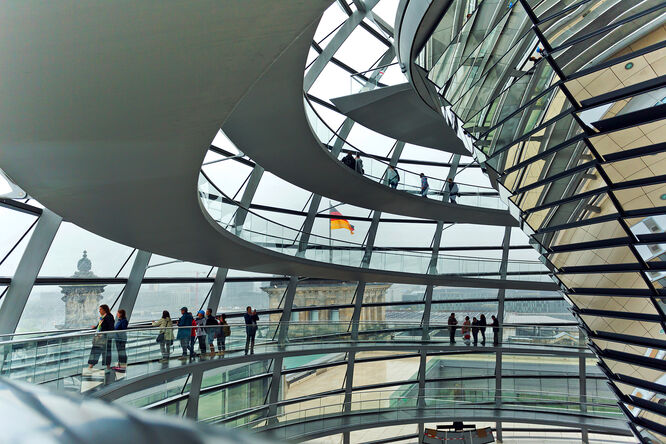
From church domes to bell towers and fanciful rooftops to sky-piercing monuments, Europe is full of climbable structures. While most lead to impressive views, the best also offer insights into the historical, artistic, and religious thinking of their times. These are some of my favorites:
In Milan, a highlight is strolling the rooftop of the city's cathedral (duomo) and the third-largest church in Europe. After taking the stairs or elevator to the top, visitors can climb up and down the roof's multiple terraces, wandering among gargoyles, statues, and frilly spires.
Each of the church's 135 lovingly decorated spires is similar, yet different. Walking among them, it's inspiring to think that every detail — each flower, saint's face, and so on — is an individual work of art carved out of pink marble centuries ago by artists who believed that few would ever see it. Their art was a gift for God to enjoy from the heavens.
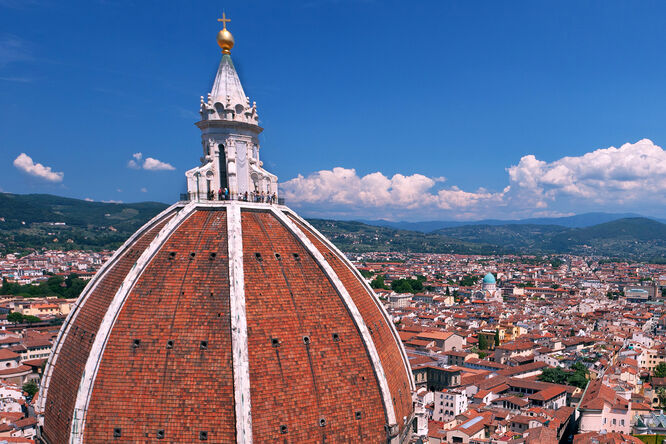
Another worthwhile climb is to the top of the dome at Florence's Duomo. Though it was built when the Gothic style of architecture dominated Europe, the Florentines decided not to cap their cathedral with a spire, but instead left it with a gaping hole. (They bet that technology would catch up with the city's vision to complete the Duomo with a dome.) In 1420, Filippo Brunelleschi won the job and built the dome that kicked off the architectural Renaissance.
Brunelleschi's dome, which inspired the likes of the US Capitol and St. Peter's Basilica in the Vatican, showed how art and science could be combined to make beauty. Today, it rewards those who climb the 463 steep, narrow steps with glorious views. Along the way climbers are treated to a close-up of the dome's Last Judgment ceiling painting, a grand view of the cathedral's interior, and a look at Brunelleschi's "dome-within-a-dome" construction.
A thoroughly different — but equally spectacular — dome to climb tops the Reichstag in Berlin. Completed in the late 19th century, the German parliament building was gutted by a mysterious fire and World War II bombs, then stood like a ghost, barely repaired, through the Cold War. But after German reunification, this historic ruin was rebuilt with a modern element: a striking glass dome.
A walkway winds all the way to the top, providing 360-degree views. Climbers see forests of skyscrapers interspersed with historic sights, such as the nearby Brandenburg Gate and the Berlin Cathedral's massive dome.
But for Germans, mindful of their dark 20th-century history, the view that matters most is inside, where a cone of mirrors points down, directing visitors' gaze toward the chamber where legislators gather. The architecture comes with a poignant message: The people are determined to keep a wary eye on their government.
Ascending the Eiffel Tower is one of Europe's great travel thrills. Built for the 1889 World's Fair, the project celebrated the 100th anniversary of the French Revolution and demonstrated that France had the wealth, knowledge, and can-do spirit to erect a structure taller than anything the world had ever seen.
Even with a reservation, many stand in long lines to take the elevators up and down. Hardy visitors can save money and time in line by climbing the stairs. It's quite a hike — 720 steps up to the second level (the top level is only accessible via elevator). But those who take the stairs get an up-close look at Gustave Eiffel's amazing engineering.
Perhaps the most memorable climb I've done in Europe was just 28 steps — on my knees — up Rome's Scala Santa (Holy Stairs) next to the Church of San Giovanni in Laterano. In AD 326, Emperor Constantine's mother brought home what was reputed to be the marble steps of Pontius Pilate's residence in Jerusalem. Jesus is said to have climbed these steps on the day he was sentenced to death. Today the steps are covered with wooden slats to protect the marble, but they're spotted with glass-covered holes to show stains from Jesus' blood on the original stairs.
For centuries, pilgrims have ascended the Scala Santa on their knees while reciting a litany of prayers. And for decades, I watched them from a staircase on the side. But finally one year, a voice inside me said "Do it!" and I tried the climb myself. With my knees screaming, weathered faithful struggling up the staircase beside me, and a fresco of a crucified Christ high above, I climbed each step, learning about both the bone structure of my legs and the value of pain when praying.
Because they're so popular, most of these sights require advance reservations. But for the savvy traveler who's up for going up, the planning — and the climbs themselves — are worth it. Whether hiking to the top of the first Renaissance dome or climbing steps on your knees, a little exertion can bring big payoffs.